Carbon Steel vs. Stainless Steel: The Ultimate Guide to Choosing Your New Knife
Carbon Steel vs. Stainless Steel: The Ultimate Guide to Choosing Your New Knife
Which knife to choose for your kitchen?
Are you searching for the perfect knife to enhance your culinary talents but are hesitating between stainless steel and carbon steel? This choice is more crucial than it appears and can transform your kitchen experience. On one hand, stainless steel shines with its resistance to corrosion. On the other hand, carbon steel is acclaimed for its exceptional sharpness and unparalleled precision.
So, which one best fits your specific needs? Let’s embark together on a journey of knowledge about these two materials to discover the knife that will become your indispensable ally behind the stove.
What is stainless steel and carbon steel?
Stainless steel is an alloy primarily composed of iron, carbon, and at least 10.5% chromium. It is this chromium that grants it exceptional resistance to corrosion and rust. Often enriched with nickel and molybdenum, it is renowned for its durability and ease of maintenance. The high-temperature fusion of these elements creates a homogeneous alloy with stainless properties, ideal for daily use.
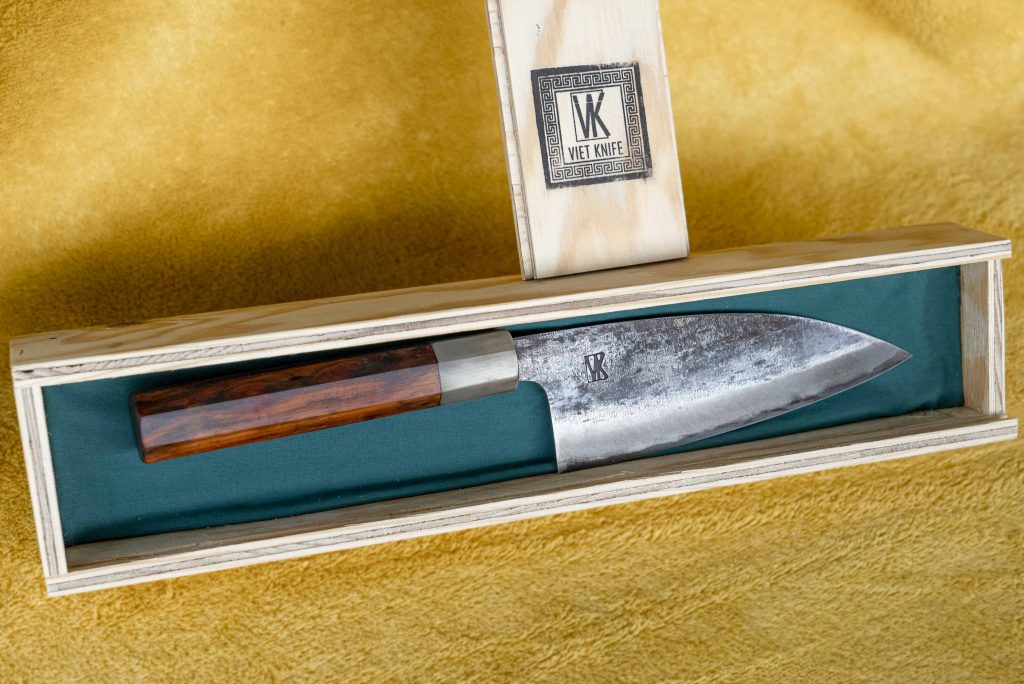
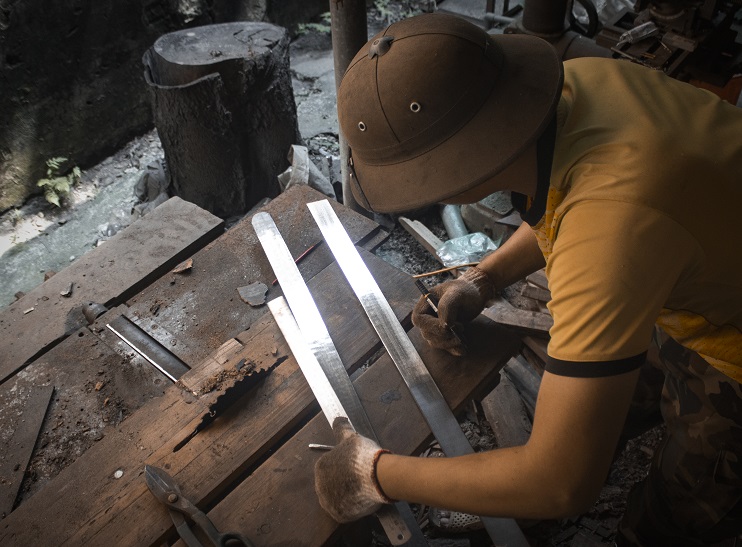
Carbon steel, on the other hand, is an iron alloy with a higher carbon content, typically between 0.5% and 1.5%. This composition offers a harder blade and a more precise edge. Often hand-forged, carbon steel knives possess a unique artisanal character. However, the absence of chromium makes them more vulnerable to corrosion, requiring regular maintenance. Heating and hammering improve the molecular structure of the blade, enhancing its performance.
In summary, the key difference lies in their chemical composition: stainless steel relies on chromium for corrosion resistance, while carbon steel favors a high carbon content for hardness and sharpness.
The advantages of stainless steel
Resistance and ease of maintenance
Stainless steel is valued for its exceptional resistance to rust and corrosion. In a kitchen where humidity and food acids are ever-present, it proves to be an ideal ally. Its blade maintains an impeccable appearance over time without requiring special care.
Everyday versatility
This material is synonymous with easy maintenance. A rinse with warm water and a quick dry are enough to keep it in perfect condition. There’s no need to oil or meticulously dry it after each use. Its durability and versatility make it the ideal companion for cooking enthusiasts looking for a reliable tool.
In summary, if you want a knife that combines reliability, minimal maintenance, and versatility, stainless steel is for you. It turns each cooking session into a truly hassle-free pleasure.
The advantages of carbon steel
Superior sharpness and precision
Carbon steel is the preferred choice of chefs for its exceptional sharpness. Its high carbon content allows for unmatched cutting precision, ideal for clean and delicate slices. Whether for finely chopping herbs, slicing sashimi, or achieving perfect brunoises, it excels in tasks requiring finesse and accuracy.
Ease of sharpening
Another major advantage is its ease of sharpening. Carbon steel sharpens easily, allowing you to maintain a razor-sharp edge with minimal effort. This is a significant benefit for those who use their knives intensively.
Unique character
Over time, carbon steel develops a unique patina, a thin protective layer that adds character to the blade while protecting it from corrosion. Each knife thus becomes a reflection of its owner, telling a personal story.
Examples of use
– Delicate vegetable slicing: Achieve ultra-thin slices without crushing the food.
– Sushi preparation: Obtain a perfect cut for raw fish, respecting its texture and flavor.
By choosing carbon steel, you opt for a precision tool with unique character that evolves with you and enhances your culinary experience.
The disadvantages of carbon steel and stainless steel
Stainless steel:
More complex sharpening: Its wear resistance can make manual sharpening more difficult, requiring more time to reshape the blade’s edge.
Carbon steel:
Sensitivity to corrosion: Without regular maintenance, it is prone to rust and corrosion, especially in the presence of humidity or acidic foods.
Demanding maintenance: Requires immediate drying after use and sometimes the application of food-grade oil to protect the blade.
Risk of damage: Lack of care can lead to deep corrosion, possibly requiring professional restoration.
In summary, your choice will depend on your priorities: do you prefer ease of maintenance, or are you willing to be meticulous for superior sharpness?
Practical comparison: Which steel for which use?
For amateurs and occasional cooks
Stainless steel: Ideal for those seeking simplicity and versatility without demanding maintenance. Perfect for everyday vegetable and meat slicing.
For passionate cooks
Carbon steel: Ideal for those who want to develop and push their creativity to the maximum, with sharpness allowing for all types of cuts, from the most precise to the most extravagant.
For professionals
Carbon steel: Valued for its precision and easy sharpening. Meets the high demands of professional kitchens.
Our recommendation
Assess your culinary habits and desired level of precision. If you prioritize ease, opt for stainless steel. If you seek performance and are willing to maintain your knife, carbon steel is for you.
TIPS FOR MAINTAINING YOUR KNIFE
1. Careful cleaning
– Stainless steel: Wash by hand with a soft sponge and warm water. Keep your blade dry at all times.
– Carbon steel: Rinse after each use, dry thoroughly, and apply a thin layer of food-grade oil to protect the blade if you don’t plan to use it for an extended period.
2. Preventing rust and maintaining sharpness
– Stainless steel: Store in a dry place and use wooden or plastic cutting boards.
– Carbon steel: Avoid humidity at all costs. Regular maintenance prevents rust and keeps the edge sharp.
3. The art of sharpening
– Stainless steel: A simple leather strop is enough to realign the edge. If the blade is too dull, sharpening with one of our sharpening whetstone is necessary. Our stones have two different grits (1000 on the blue side and 6000 on the white side) for precise results.
– Carbon steel: The process is the same; leather is perfect for a first step, and the white side of our water stones can serve this purpose as well. If your blade is very dull, start with a coarse grit (1000) and finish with a fine grit (6000).
You can check our video to perfect your technique.
4. Proper storage
– Magnetic bar: Provides easy access while preventing impacts.
– Wooden knife block: Protects from dust and humidity.
– Individual sheaths: Ideal for transport or drawer storage.
By caring for your knives, you extend their lifespan and ensure optimal performance, making each culinary experience even more enjoyable.
conclusion
The knife is more than just a tool; it’s an extension of your hand in the kitchen. Stainless steel is perfect if you’re looking for simplicity and versatility without worrying about maintenance. Carbon steel, on the other hand, will appeal to enthusiasts seeking precision and performance, ready to build a strong connection with their tool as it develops a unique patina over time.
Discover our selection of Vietnamese handcrafted knives in stainless steel and carbon steel on our online store, and find the one that will elevate your culinary skills!
FAQ on stainless steel and carbon steel knives
1. Is carbon steel harder to maintain compared to stainless steel?
Not hard, but it does require more attention. Without drying after each use and occasional oiling if unused for extended periods, it is prone to rust. However, this regular maintenance ensures exceptional longevity and cutting quality.
2. Why do professional chefs often prefer carbon steel knives?
Because they offer superior sharpness and unparalleled cutting precision, essential in professional kitchens. Additionally, they are easy to sharpen, making them ideal for intensive use.
3. Which type of knife is best suited for daily home use?
Stainless steel knives are recommended for everyday use. They offer a good balance between performance and ease of maintenance, without requiring special care.
4. Is it possible to combine the benefits of both types of steel?
Absolutely! Some Vietnamese artisanal knives use a forging technique that combines a carbon steel core for sharpness, encased in stainless steel for corrosion resistance. This way, you get the best of both worlds.
Ready to make the right choice? Visit our online store to discover our Vietnamese handcrafted knives and find the one that will become your kitchen ally!